What humans find appealing is determined by many factors; among them fashion, prejudice, intolerance and ignorance. Yet, it is argued here, there exists a ``Generic Grammar'' (cf. Chomsky's Deep Structure), mostly hidden and subconscious, which plays a decisive part in what humans subjectively find ``appealing.''
The ``Generic Grammar'' may be determined both phylogenetically and ontogenetically, by genetic and social factors; i.e., by influences originating from the past of the species as well as of the individual. The relative weight of these two factors can hardly be made precise.
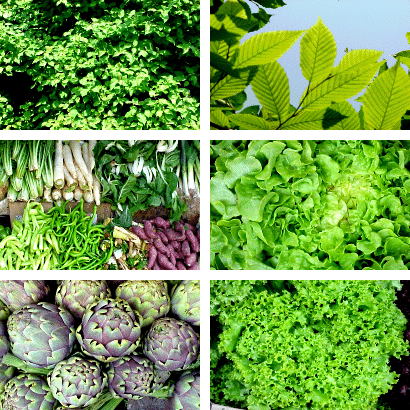
We take it for granted here that the most decisive influences forming a ``Generic Grammar'' are those of the natural surroundings: plants, trees, animals, mountains and other landscape formations, clouds and water waves of all scale, both static and dynamic. These are the geometric forms which were present when humanity evolved. And these ``Generic Grammar'' forms, it is claimed here, are those which human individuals are most accustomed with and find intuitively appropriate and appealing. These are also the forms which no regiment of terror so far could surpress. We shall subsume all styles of this type under the name ``canonic.''
We do not know if there are other forms which do not originate from nature but which are nonetheless accessible by artistic intuition. They might be derivable from other sources; maybe from physiological artefacts of the human brain or the nervous system, maybe from transcendence.
Art, in particular architecture, may have many different agendas; for instance to provoke and draw attention to buildings, or to state a particular message, both by the artist and by the client. Boundedness by cost constraints is often a decisive issue. Yet, as far as it attempts to build dwellings whose inhabitants feel comfortable in, it has to confront itself with the ``Generic Grammar,'' in particular with the geometric forms found in nature.
It is claimed that, historically, modern architecture took a very different development than, say, modern music: Whereas the latter transformed into more and more complex expressions which presently resemble white noise at first listening, architecture turned simple, monotonous and repetitive. One important factor for this may have been cost; another the willingness of many architects to disguise ornamentation and to renunciate conservative dogmatism.
As a result, humans are confronted with dwellings of doubtful esthetic quality, yet very solidly built (mostly steel, concrete and bricks) and equipped with high hygienic standards. Buildings that sicken the soal.
There is no easy remedy. Sometimes, cures are sicknesses themself. Nevertheless, it is claimed that the science of complexity may be helpful in allowing for the automatic, cost-effective, generation of new estetically appealing ``fractal forms.'' Furthermore, what is needed is a noncynical, positive re-evaluation of the ``classical'' periods, as well as of indigenous art and the geometry of ornament.
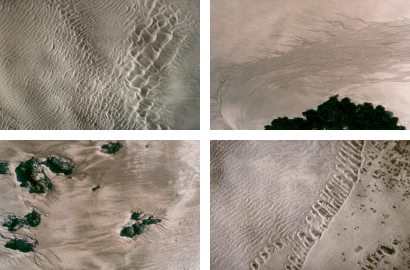
Since Mandelbrot's successive marketing of fractal forms, they are with us everywhere. For example, when we look at the surface of the earth from above (cf. Fig. 3) we see a complex pattern of contours. Areal photography has transformed the way we perceive landscapes permanently: from the smooth forms presented in the maps to the rugged, wrinkeled geometries of reality.
In the most general sense, fractal geometry appears similar on all resolution scales. Thereby, the fractal dimension serves as a measure of irregularity of the geometric shape. The more irregular a shape, the higher the dimension.
Fractals are often linked to complex systems because of the geometries resulting from nonlinear maps which often govern the evolution of such systems. Yet, there appears to be an amazing antinomy here: structures which look complex at first glance can be built by extremely simple rules. The shape of a fern, for instance, can be produced by a two-line program, sometimes refered to as iterative algorithm. There is simplicity in complexity. And this may be one of the reasons why this geometry occurs very often in nature. The ``code'' for producing it may be rather simple and short indeed, yet the phenotype appears rich in form. Or does it not?
It is just this simplicity, it is claimed here, which gives rise to the weird monotonous, unsophisticated and uneasy feelings humans often have when they look at pictures of fractals. In a queer sense, we are able to realize that the phenotype is the product of a perpetual recursive reiteration of a very simple algorithm.
How come that we like the natural geometric forms which may also arise from simple genotypes? Probable it is just our impossibility to comprehend the simplicity behind the natural forms which prevent us from experiencing monotony in nature.
Rather than theoretically arguing about the value of particular styles, we present some cases of different architectural and geometric forms. By doing this, we are aware of the fact that, strictly speaking, such examples cannot claim to be of general relevance but remain anectodal.
As many capitals of Europe, Vienna in Austria is a city whose architecture is still dominated by buildings erected a long time ago, starting from the middle ages. In the late 19th century, land specultion and population growth transformed its previous outskirts from a lush garden landscape into densely populated and packed sections of apartement blocks as we know them today. During the second world war, the air raids of the Allied Forces did not erase the architectural heritage, as for instance in Germany. The prosperous years afterwards were used mainly to build cost-effective ``living boxes'' (made from mostly pre-fabricated concrete elements) for the average citizen. These activities mainly took place far away from the center. Downtown, there is still (almost) no skyscraper in sight. The Vienna Woods which its lush vegetation is a green belt which encircles one half the city.
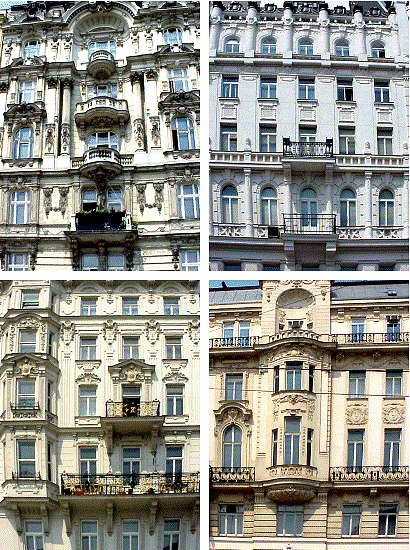
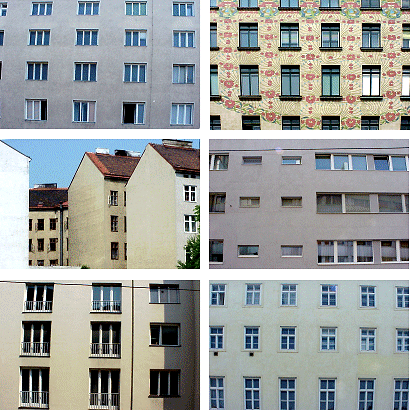
The houses erected before and around 1900 show a rich ornamentation and detail (cf. Fig. 1) on their street facades and almost none on their reverse side (``Aussen hui, innen pfui''). The houses erected or renovated afterwards, appear comparably dull (cf. Fig. 2).
-----
-----